Elon Musk Personality Economy

Elon Musk’s Dojo 3 Call: Technical Meritocracy Meets the Personality Economy

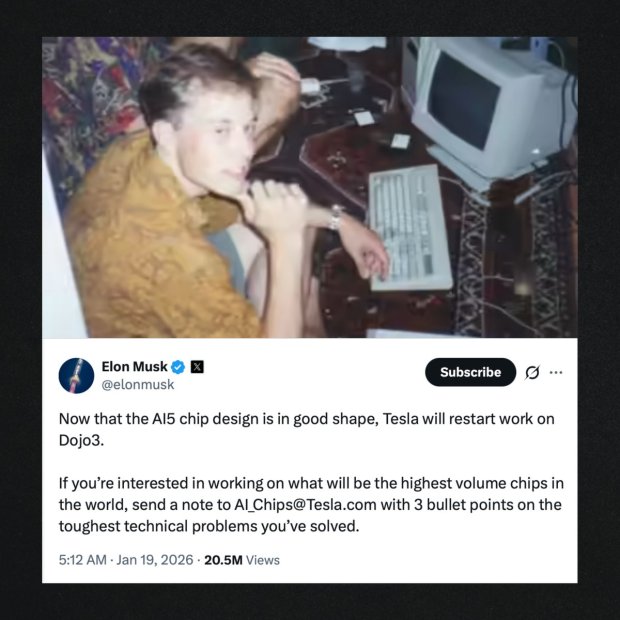
Elon Musk posted a strikingly simple recruiting message for Tesla’s restarted Dojo 3 supercomputer project:

Elon Musk Personality Economy

“No résumé. No degree. Just send 3 bullets of tough technical problems you actually solved to AI_Chips@Tesla.com (mailto:_Chips@Tesla.com)”

Within hours the post garnered thousands of likes, hundreds of replies, and a flood of speculation. Some celebrated the purest form of meritocracy imaginable; others worried about signal-to-noise ratio or suspected it was mostly performative. Yet beneath the hype lies one of the clearest real-time demonstrations yet of how the Personality Economy is infiltrating even the most elite engineering domains.

Why this format is personality-first (even in hard tech)

Traditional semiconductor/AI-chip hiring pipelines demand:

  • PhD or elite master’s degree
  • Years at NVIDIA / AMD / Google TPU teams
  • Long publication list or patent portfolio
  • Polished LinkedIn + referrals

Musk’s method discards almost all of those signals in favor of one question: “Show me you have already solved difficult, real problems with AI tools.”

The three-bullet constraint forces extreme conciseness and clarity—skills that correlate strongly with:

  • Ability to prioritize what matters (judgment)
  • Capacity to explain complex work simply (communication & emotional intelligence)
  • Evidence of self-directed learning and iteration (adaptability and learning speed)

These are exactly the traits Steven Bartlett and Simon Sinek highlight when they argue for attitude and learning velocity over credentials. In a world where Grok, Claude, Gemini, and open-source models let anyone accelerate prototyping, the person who can quickly turn vague goals into working silicon or training runs becomes irreplaceable.

Dojo 3 context: why the bar is so high yet so open

Tesla quietly shelved earlier Dojo ambitions after the AI5 chip design wrapped, then quietly revived the program in late 2025 with the explicit goal of building the world’s highest-volume AI training chips. That means Dojo 3 engineers must solve problems at the bleeding edge of:

  • Custom interconnect fabrics
  • Extreme power density
  • Software-hardware co-design for trillion-parameter models
  • Cost-per-FLOP at planetary scale

Yet Musk is betting that the fastest path to those breakthroughs is not poaching the usual suspects from the usual pedigrees, but casting the widest possible net for people who have already proven they can wrestle hard technical reality using today’s AI assistance.This is the Personality Economy logic applied to frontier hardware: AI has democratized access to simulation tools, code generation, optimization literature, and even architecture exploration. What remains scarce is the combination of grit, pattern recognition, taste in experimentation, and willingness to fail repeatedly until something works. Those qualities do not reliably appear on a CV.

Counterpoints: when pure attitude isn’t enough

Skeptics rightly point out risks:

  • Volume of emails could overwhelm recruiters (though Tesla likely uses AI filtering + human spot-checks).
  • Self-reported bullets are easy to embellish or outright fabricate.
  • Certain chip-design subtleties (e.g., analog layout parasitics, foundry process quirks) still require deep tacit knowledge that only comes from years on the floor.
  • Team composition needs balance: visionaries + fast learners must be paired with domain veterans who prevent reinventing broken wheels.

The site’s earlier pieces on hiring for attitude consistently note this tension. The strongest outcome is rarely 100 % attitude or 100 % pedigree—it is deliberate complementarity.

What this means for the rest of us

Whether or not you are aiming for Tesla’s AI chip team, Musk’s experiment is a loud signal:

  • Document your real problem-solving stories now (GitHub repos, blog posts, Twitter threads, short Loom videos).
  • Practice distilling complex work into three crisp, outcome-focused bullets.
  • Treat AI as a co-pilot that amplifies your curiosity and persistence, not a magic shortcut.
  • Build a public trace of how you think and iterate—because in the Personality Economy, your demonstrated character and learning velocity increasingly serve as your primary credential.

The knowledge economy rewarded accumulation.

The Personality Economy rewards what you do with what is already abundant.

If three powerful bullets can open the door to one of the most ambitious AI hardware projects on Earth, imagine what the same clarity and evidence could unlock in your own field. What tough technical (or business / creative / operational) problem did you solve lately using AI tools?

Steven Bartlett: The Poster Child of the Personality Economy

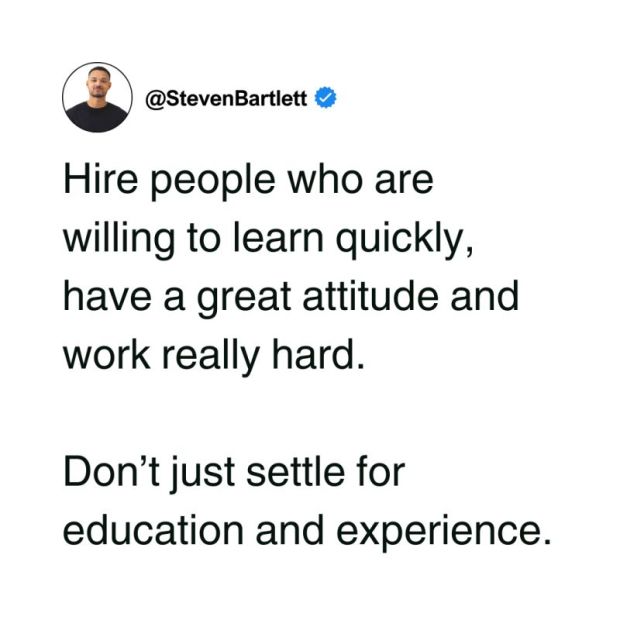
In a world still clinging to the benchmarks of the old Knowledge Economy, Steven Bartlett stands as a loud, successful contradiction to the traditional rules of hiring. Bartlett, a 33-year-old British entrepreneur and the youngest-ever investor on BBC’s Dragons’ Den, recently shared a clear directive for modern leaders: “Hire people who are willing to learn quickly, have a great attitude and work really hard. Don’t just settle for education and experience.”

Steven Bartlett Personality Economy

This philosophy isn’t just a trend; it is the practical application of the shift toward a personality-driven market.

Moving Beyond the “Knowledge” Trap

The traditional Knowledge Economy values specialized skills and degrees above all else. However, as the book The Personality Economy explains, the rapid advancement of artificial intelligence and digital tools has made information and technical knowledge easily accessible to everyone.

Bartlett himself is a prime example of this decline in the value of traditional education. His CV lists his education simply as “Dropout”. Despite this, he launched Social Chain AG at 21 and took it public with a market cap of approximately $300 million by the age of 27. His success was driven not by a certificate, but by entrepreneurship, marketing savvy, and social media expertise—qualities that are difficult for machines to replicate.

Why Attitude Wins in the New Economy

When Bartlett argues for prioritizing “learning speed” and “attitude,” he is identifying the core components of the Personality Economy:

  • Emotional Intelligence (EI): The ability to build relationships and communicate effectively is now a key differentiator in the job market.
  • Adaptability: As technology automates data analysis and research, the human value lies in being flexible and creative in how we solve problems.
  • Authenticity: Bartlett’s personal brand is built on being a “media owner” and “media IP” creator. In this new paradigm, individuals are hired for their overall “package” of personality and experience rather than just their qualifications.

A Skeptical Look at the “Attitude Only” Approach

While Bartlett’s stance is compelling, a rigorous analysis requires us to look at the gaps in this logic.

  1. The Measurement Gap: Education and experience provide a measurable baseline of discipline and foundational knowledge. How do we objectively measure “great attitude” or “hard work” during a 45-minute interview without falling into the trap of hiring for “cultural fit,” which can often lead to a lack of diversity?
  2. Domain Necessity: While attitude is vital in marketing or social media, certain industries—like medicine or engineering—cannot yet bypass formal education for “willingness to learn.”
  3. The Burden of Training: Hiring for potential means the organization must have the resources to train. If a company is in a high-pressure “scale-up” phase, it may not have the luxury of waiting for a “fast learner” to catch up.

Preparing Your Organization

Bartlett’s companies, such as Chapter 2, specifically focus on helping companies hire the right people more efficiently. This aligns with the advice for HR professionals in the Personality Economy: recruitment processes must evolve to assess soft skills like creativity and emotional intelligence alongside traditional qualifications.

By focusing on the unique human qualities that AI cannot automate, leaders can build teams that are not just knowledgeable, but truly irreplaceable. Steven Bartlett didn’t wait for the economy to change; he built his success on the very principles that are now reshaping the future of work.

Hiring for Attitude Over Skills

In today’s rapidly changing job market, the debate over hiring for attitude versus skills has gained prominence. Simon Sinek’s assertion, “You don’t hire for skills, you hire for attitude. You can always teach skills,” encapsulates this perspective. This approach emphasizes the importance of inherent qualities over specific competencies, which fits in the Personality Economy.​

The Rationale Behind Hiring for Attitude:

  1. Adaptability: Employees with a positive attitude are more likely to embrace change and adapt to new challenges, a crucial trait in dynamic industries.​
  2. Cultural Fit: Hiring individuals whose values align with the organization’s culture fosters a cohesive work environment, enhancing collaboration and morale.​
  3. Trainability: An individual with the right attitude is often more open to learning and development, making it easier to impart necessary skills.​

Supporting Evidence:

  • Person–Organization Fit: Research indicates that employees who align with their organization’s culture tend to exhibit higher job satisfaction and commitment, leading to reduced turnover.​
  • Soft Skills Significance: Attributes such as communication, teamwork, and problem-solving are increasingly valued by employers, often outweighing technical skills in certain roles.​Reuters

Counterarguments:

  1. Role-Specific Requirements: Certain positions necessitate specialized skills that cannot be quickly taught, making immediate proficiency essential.​
  2. Training Resources: Not all organizations have the capacity to train employees extensively, making pre-existing skills a practical necessity.​
  3. Measurability: Skills are often more quantifiable than attitudes, simplifying the assessment process during hiring.​

Balancing Attitude and Skills:

While attitude plays a pivotal role in an employee’s success, a balanced approach that considers both attitude and requisite skills is often most effective. This ensures that new hires can integrate smoothly into the company culture while also fulfilling the technical demands of their roles.​

Simon Sinek’s perspective therefore highlights the enduring value of attitude in the workplace. However, the optimal hiring strategy may involve a nuanced evaluation of both attitude and skills, tailored to the specific needs of the organization and the nature of the position.​

The rise of social skills: A new era for leadership in the Personality Economy

In today’s rapidly evolving workplace, the qualities that define effective leadership are undergoing a profound transformation. I notice that personality traits are becoming more and more important in the selection of leaders, and expertise less.

personality economy

For decades, traditional markers of executive success—such as expertise in managing financial and material resources—dominated the criteria for hiring top-level leaders. However, as the world becomes increasingly interconnected and complex, organizations are placing greater emphasis on a different set of skills: social and interpersonal abilities.

The chart titled “Help Wanted: CEOs Who Are Good with People” captures this shift vividly. Since 2007, companies advertising C-suite openings have steadily increased their focus on candidates with strong social skills, while de-emphasizing operational expertise. This trend reflects a broader cultural and economic shift toward what some are calling the “personality economy,” where emotional intelligence and people-centric leadership take center stage.

Breaking down the data

The data, drawn from nearly 5,000 C-suite job descriptions analyzed by Russell Reynolds Associates, compares changes relative to the year 2000. Two distinct trends emerge:

  • Social skills on the rise: Job descriptions emphasizing social skills have seen a consistent upward trajectory since 2007, now surpassing a 25% increase compared to 2000. This includes qualities like emotional intelligence, collaboration, communication, and the ability to inspire and manage teams effectively.
  • Operational expertise declining: In contrast, job descriptions prioritizing operational skills—such as managing financial and material resources—have plummeted by nearly 40% over the same period.

The divergence between these two skill sets highlights a significant redefinition of what it means to lead in today’s world.

Why are social skills more valued than ever?

Several factors explain this shift:

  1. The rise of team-oriented workplaces:
    Modern organizations increasingly rely on cross-functional teams to solve complex problems. Leaders who can foster collaboration and navigate interpersonal dynamics are better equipped to drive innovation and productivity.
  2. Globalization and diversity:
    As companies expand globally, leaders must navigate cultural differences and build inclusive environments. Social skills like empathy and adaptability are essential for fostering trust across diverse teams.
  3. The digital transformation:
    Technology has automated many operational tasks traditionally managed by executives. This frees leaders to focus on higher-order responsibilities like vision-setting, relationship-building, and motivating employees.
  4. Employee expectations:
    Today’s workforce values purpose-driven leadership and meaningful connections with their employers. Leaders who can engage employees on a personal level are more likely to retain top talent and maintain morale.

What this means for aspiring leaders

For those looking to climb the corporate ladder, this data sends a clear message: technical expertise alone is no longer enough. To succeed in today’s competitive job market, aspiring leaders must cultivate their social skills alongside their technical abilities. This includes:

  • Developing emotional intelligence through active listening and empathy.
  • Building strong communication skills to inspire and align teams.
  • Learning how to manage conflict constructively.
  • Embracing diversity and fostering inclusivity in decision-making processes.

The rise of social skills as a priority in C-suite hiring therefore reflects a broader societal shift toward valuing human connection in an increasingly digital world. As companies navigate unprecedented challenges—from technological disruption to global crises—the ability to lead with empathy, authenticity, and collaboration has never been more critical.

For organizations seeking transformative leadership or individuals aspiring to lead, one thing is clear: the future belongs to those who are good with people.

Personality is the New Keyword: How The Personality Economy is Changing SEO

The field of search engine optimization has been significantly impacted by the rise of the Personality Economy (SEO). Prior to the shift toward a more personable and authentic approach to marketing, the main focus of SEO was on keywords and content. As a result, the way that search engines rank websites has significantly changed.

personality
‘Personality’ as seen by a content robot.

Personality is key

The rising significance of personal branding is one of the Personality Economy’s most significant effects on SEO. Personal branding is everything in the current economic paradigm, and success depends on having a strong internet presence. This means that people need to concentrate on developing a genuine, memorable, and distinctive personal brand.

Making entertaining, high-quality material that is relevant and timely is one approach to accomplish this. People are more likely to rank highly in search results if they can give their unique perspective and demonstrate their knowledge. This means that businesses need to spend money on a content strategy that puts creativity and authenticity ahead of keyword stuffing and other antiquated strategies.

The Personality Economy and Social Media

Social media’s influence on online reputation is a key component of the Personality Economy. It is now possible for people and organizations to communicate with a global audience because of the growth of social media sites like Twitter, LinkedIn, and Instagram. Because unpleasant or irrelevant content may spread quickly and harm one’s personal brand, maintaining a consistent and positive online presence is now more crucial than ever.