Elon Musk posted a strikingly simple recruiting message for Tesla’s restarted Dojo 3 supercomputer project:
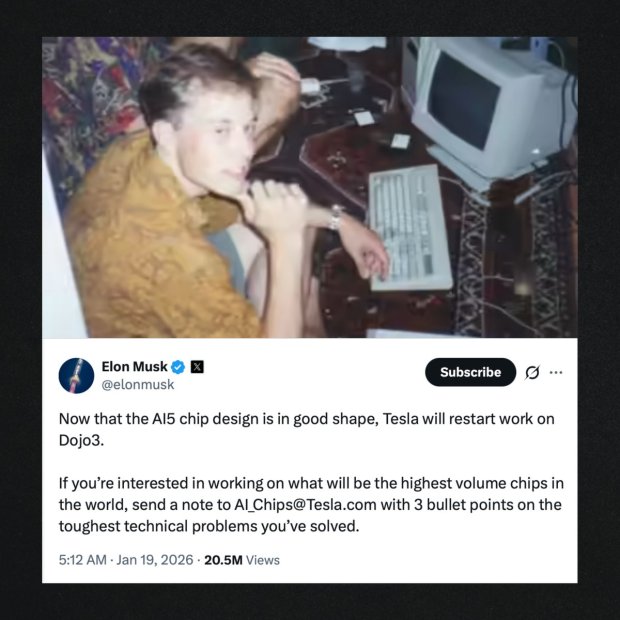
“No résumé. No degree. Just send 3 bullets of tough technical problems you actually solved to AI_Chips@Tesla.com (mailto:_Chips@Tesla.com)”
Within hours the post garnered thousands of likes, hundreds of replies, and a flood of speculation. Some celebrated the purest form of meritocracy imaginable; others worried about signal-to-noise ratio or suspected it was mostly performative. Yet beneath the hype lies one of the clearest real-time demonstrations yet of how the Personality Economy is infiltrating even the most elite engineering domains.
Why this format is personality-first (even in hard tech)
Traditional semiconductor/AI-chip hiring pipelines demand:
- PhD or elite master’s degree
- Years at NVIDIA / AMD / Google TPU teams
- Long publication list or patent portfolio
- Polished LinkedIn + referrals
Musk’s method discards almost all of those signals in favor of one question: “Show me you have already solved difficult, real problems with AI tools.”
The three-bullet constraint forces extreme conciseness and clarity—skills that correlate strongly with:
- Ability to prioritize what matters (judgment)
- Capacity to explain complex work simply (communication & emotional intelligence)
- Evidence of self-directed learning and iteration (adaptability and learning speed)
These are exactly the traits Steven Bartlett and Simon Sinek highlight when they argue for attitude and learning velocity over credentials. In a world where Grok, Claude, Gemini, and open-source models let anyone accelerate prototyping, the person who can quickly turn vague goals into working silicon or training runs becomes irreplaceable.
Dojo 3 context: why the bar is so high yet so open
Tesla quietly shelved earlier Dojo ambitions after the AI5 chip design wrapped, then quietly revived the program in late 2025 with the explicit goal of building the world’s highest-volume AI training chips. That means Dojo 3 engineers must solve problems at the bleeding edge of:
- Custom interconnect fabrics
- Extreme power density
- Software-hardware co-design for trillion-parameter models
- Cost-per-FLOP at planetary scale
Yet Musk is betting that the fastest path to those breakthroughs is not poaching the usual suspects from the usual pedigrees, but casting the widest possible net for people who have already proven they can wrestle hard technical reality using today’s AI assistance.This is the Personality Economy logic applied to frontier hardware: AI has democratized access to simulation tools, code generation, optimization literature, and even architecture exploration. What remains scarce is the combination of grit, pattern recognition, taste in experimentation, and willingness to fail repeatedly until something works. Those qualities do not reliably appear on a CV.
Counterpoints: when pure attitude isn’t enough
Skeptics rightly point out risks:
- Volume of emails could overwhelm recruiters (though Tesla likely uses AI filtering + human spot-checks).
- Self-reported bullets are easy to embellish or outright fabricate.
- Certain chip-design subtleties (e.g., analog layout parasitics, foundry process quirks) still require deep tacit knowledge that only comes from years on the floor.
- Team composition needs balance: visionaries + fast learners must be paired with domain veterans who prevent reinventing broken wheels.
The site’s earlier pieces on hiring for attitude consistently note this tension. The strongest outcome is rarely 100 % attitude or 100 % pedigree—it is deliberate complementarity.
What this means for the rest of us
Whether or not you are aiming for Tesla’s AI chip team, Musk’s experiment is a loud signal:
- Document your real problem-solving stories now (GitHub repos, blog posts, Twitter threads, short Loom videos).
- Practice distilling complex work into three crisp, outcome-focused bullets.
- Treat AI as a co-pilot that amplifies your curiosity and persistence, not a magic shortcut.
- Build a public trace of how you think and iterate—because in the Personality Economy, your demonstrated character and learning velocity increasingly serve as your primary credential.
The knowledge economy rewarded accumulation.
The Personality Economy rewards what you do with what is already abundant.
If three powerful bullets can open the door to one of the most ambitious AI hardware projects on Earth, imagine what the same clarity and evidence could unlock in your own field. What tough technical (or business / creative / operational) problem did you solve lately using AI tools?
 The Personality Economy