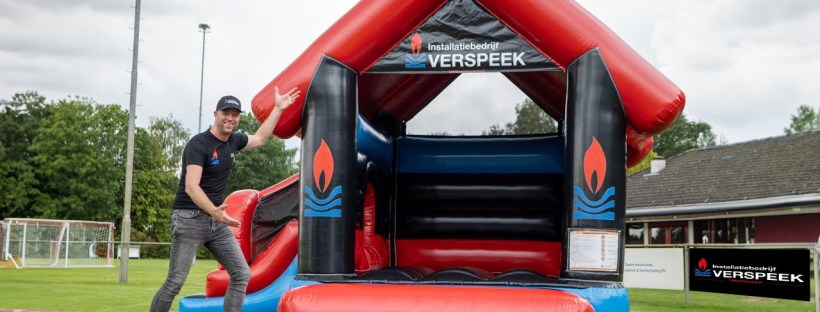
While much of the debate around the Personality Economy focuses on tech founders, AI engineers, and media entrepreneurs, one of the clearest real-world examples comes from a thirty-person plumbing and installation business in a small village in the south of the Netherlands. Martijn Verspeek runs Installatiebedrijf Verspeek in Valkenswaard, and his new book “Goeiegast” (roughly:
“Good Guy”), co-written with journalist Eddy Buiting, has been the number one management book in the country for more than a hundred days.
What is a village plumber doing at the top of a management bestseller list? The short answer: he hires for personality, and everything else follows.
No salary talk. Still a waiting list.
When Verspeek interviews a candidate, he doesn’t mention what they will earn. He doesn’t ask for a list of certificates or push them through a standardised assessment. He simply tries to find out whether the person in front of him is a goeiegast or a goeievrouwke (a good guy, a good woman). Someone with the right attitude, humour and character.
The result is the kind of number every HR director quietly dreams about: a waiting list of more than thirty people who want to work there. In an industry that spends every conference complaining about the shortage of skilled technicians, a small company in Brabant has people queuing up, without knowing what the job pays.
“I think it’s perfectly normal to have a bit of love for your employees. The whole country is moaning that they can’t find people, and then I walk into companies where the director has a parking space right next to the front door while the rank and file get soaked when it rains.”
Why this fits the Personality Economy
The argument behind the Personality Economy is that once AI and digital tools make knowledge widely available, the scarce resource is no longer what you know; it is who you are and how you work with others. Verspeek makes the same argument from the other side of the labour market. Technical skill can be taught; a sense of humour, reliability, and genuine care for a customer cannot.
Elon Musk, from a very different corner of the economy, put it bluntly in a 2023 interview:
“The biggest mistake, in general, I’ve made, is to put too much of a weighting on someone’s talent and not enough on their personality. I think it actually matters whether somebody has a good heart, it really does.”
A Tesla founder and a Brabant plumber do not agree on much, but on this they seem to agree completely. Verspeek’s choices line up almost point for point with the traits Steven Bartlett and Simon Sinek describe in earlier pieces on this site:
- Attitude over credentials. Verspeek hires people who fit the culture and trusts his team to teach them the trade.
- Trust over control. There are no rules, only agreements. Monteurs drive identical vans, but every driver fits out the inside exactly as they like.
- Relationships over transactions. Formal performance reviews are replaced by what he calls kampvuurgesprekken (campfire conversations) in which people talk like adults instead of being “judged” once a year.
- Continuity over maximisation. He deliberately caps the company at around thirty people and aims for long-term health rather than growth for its own sake.
The PSV-inspired changing room is the most quoted detail; every employee has their own chair, their own locker, their own photograph on the wall, and work clothes that are washed by the company with their name on them. It is a small, almost silly thing. It is also a very precise signal: you are seen as a person, not as a pair of hands.
A sceptical look
It would be too easy to turn Verspeek into a poster for “hire for attitude and the rest sorts itself out”. A few honest objections:
- Scale matters. Running a thirty-person family business in one region is very different from running a thousand-person company across several countries. Some of what works here works because the company is small on purpose.
- Technical skill still matters. An installation engineer who is lovely but cannot wire a heat pump safely is a liability. Attitude is the filter, not the substitute.
- “Culture fit” has a dark side. Hiring people who feel like one of us can quietly turn into hiring people who look like one of us. Any company copying this approach has to ask honestly who ends up on that waiting list — and who never applies in the first place.
Verspeek is well aware of the “small and on purpose” advantage. He says so himself in the book. That honesty is part of why the story is convincing rather than preachy.
What to take away from this
The Personality Economy is often framed as a response to AI: if the robots know everything, humans compete on character. Verspeek arrived at the same conclusion through something much older — a Brabant farmer’s common sense, as the Dutch would say. Look after your people, and they will look after your customers. Hire for who someone is, and worry about the certificates later. For HR, that points to a few practical shifts:
- Rewrite the job interview around behaviour and values, not around the CV.
- Replace the annual review with shorter, more honest conversations; campfires, not courtrooms.
- Invest in the small signals (the changing room, the van, the name on the jacket) that tell employees they are individuals, not headcount.
The knowledge economy rewarded what you had studied. The Personality Economy rewards how
you treat the people around you. A village plumber has just sold more than a hundred thousand
copies of a book making that point. Maybe it is time the rest of us listened.

